How to Choose the Best Phone in 2026: Complete Buying Guide
Buying a new phone sounds simple until you actually start comparing models. One phone has a better camera, another has faster charging, another promises longer software updates, and another looks cheaper but cuts corners in storage, display quality, or battery life.
The truth is simple: the best phone is not always the newest phone, the most expensive phone, or the phone with the biggest number on the spec sheet. The best phone is the one that fits your daily use, your budget, and the things you actually care about.
This guide will help you understand what to check before buying a smartphone in 2026, whether you are looking for a budget phone, a gaming phone, a camera phone, a flagship device, or simply a reliable daily phone that will last for years.
If you already have a few models in mind, you can also use the TelefoneArena phone comparison tool or try the AI Phone Recommender to narrow your choices faster.
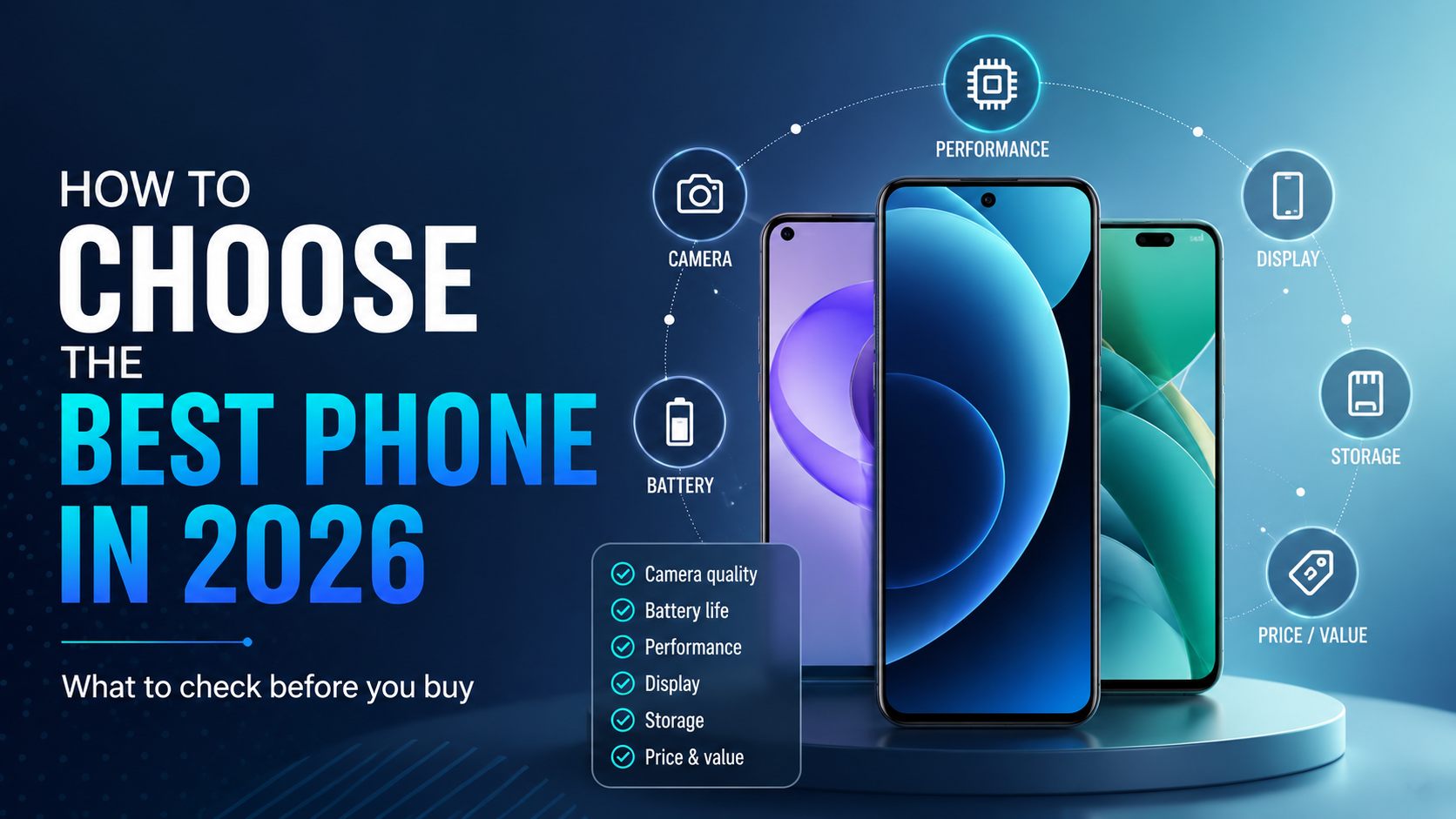
Quick Smartphone Buying Checklist
| What to Check | Why It Matters | Best Choice For |
|---|---|---|
| Budget | Helps you avoid overpaying for features you may not use | Every buyer |
| Processor | Affects speed, gaming, multitasking, and long-term smoothness | Gamers and power users |
| RAM and Storage | Controls app performance and how much space you have for photos, videos, and apps | Heavy users and content creators |
| Battery Life | Determines whether your phone can survive a full day | Students, workers, travelers |
| Camera Quality | Important for photos, video, social media, travel, and family moments | Creators and photography users |
| Display | Affects reading, gaming, movies, scrolling, and outdoor visibility | Everyone |
| Software Updates | Improves security, features, and long-term value | Long-term buyers |
| Charging Speed | Useful if you need quick top-ups during the day | Busy users |
| Build Quality | Protects the phone from daily wear, drops, water, and dust | Long-term users |
Start With Your Real Needs, Not the Spec Sheet
The biggest mistake many buyers make is starting with numbers. They compare megapixels, RAM, charging watts, benchmark scores, and screen brightness before asking the most important question: what do I actually need this phone to do?
Before you buy, think about your current phone. What bothers you the most?
- Does the battery drain too fast?
- Is the camera weak at night?
- Does the phone lag when switching between apps?
- Is storage always full?
- Is the screen hard to see outdoors?
- Do you want better gaming performance?
- Do you want longer software support?
Your answer should guide your purchase. If your main problem is battery life, do not pay extra only for a better zoom camera. If you mainly use TikTok, Instagram, YouTube, WhatsApp, and browsing, you may not need the most powerful flagship processor. If you record videos every day, camera consistency and storage matter more than a flashy design.
You can browse different phone categories on TelefoneArena depending on your needs:
Set a Smart Budget Before You Start Comparing
A clear budget makes phone shopping much easier. Without a budget, it is easy to move from a $300 phone to a $500 phone, then to a $700 phone, then suddenly you are looking at a $1,200 flagship you never planned to buy.
In most cases, phone buyers fall into three main groups:
Budget Phones
Budget phones are usually the best option if you need a reliable daily device for calls, messaging, browsing, YouTube, social media, and light apps. Look for a clean display, good battery life, at least 128GB storage, and a processor that can handle normal use without heavy lag.
You can start from the Budget Phones section if your main goal is value.
Mid-Range Phones
Mid-range phones are often the best choice for most people. They usually offer better cameras, smoother displays, faster charging, stronger processors, and better designs without reaching flagship prices.
If you want a phone that feels modern but does not destroy your budget, check the Mid-Range Phones section.
Flagship Phones
Flagship phones are made for users who want the best performance, premium cameras, long software support, high-end displays, wireless charging, water resistance, and stronger build quality. They cost more, but they usually last longer and keep better resale value.
If you want the best experience regardless of price, browse the Flagship Phones section.
Performance: Processor, RAM, and Storage
Performance is not only about gaming. A faster phone also opens apps quicker, switches between tasks more smoothly, edits photos faster, records video more reliably, and stays usable for more years.
For normal daily use, you do not need the highest benchmark score. But you should avoid very weak processors if you plan to keep the phone for three or four years. Apps become heavier over time, and a slow phone today may feel much worse after future updates.
What to look for:
- Processor: Choose a modern chip from Qualcomm Snapdragon, Apple A-series, MediaTek Dimensity, Google Tensor, or Samsung Exynos depending on the phone and price.
- RAM: 6GB is acceptable for basic use, 8GB is better for most users, and 12GB or more is useful for gaming and heavy multitasking.
- Storage: 128GB is the minimum you should consider in 2026. If you record a lot of videos or install many games, 256GB is safer.
If you play heavy games, edit videos, or use your phone as your main work device, do not choose based only on price. A stronger processor and more storage can save you from replacing the phone too early.
Camera: Do Not Trust Megapixels Alone
A 200MP camera does not automatically beat a 50MP camera. Camera quality depends on sensor size, lens quality, image processing, stabilization, software, night mode, zoom quality, and video performance.
If you care about photography, check real camera features instead of only reading megapixel numbers.
For photos, focus on:
- Main camera sensor quality
- Night mode performance
- Dynamic range
- Portrait mode edge detection
- Ultra-wide camera quality
- Telephoto or zoom camera availability
For video, focus on:
- 4K recording quality
- Stabilization
- Autofocus reliability
- Microphone quality
- Color consistency between lenses
- Front camera video quality
If you create TikTok videos, YouTube Shorts, Instagram Reels, or family videos, video quality may matter more than still photos. iPhones are usually strong in video consistency, while many Android flagships offer more zoom flexibility and manual control.
For camera-focused models, visit the Camera Phones section. You can also compare camera specifications directly using the phone comparison tool.
Battery Life and Charging: Bigger Is Not Always Better
Battery capacity is important, but it is not the full story. A phone with a 5,000mAh battery can last longer than another phone with a bigger battery if it has a more efficient processor, better software optimization, and a smarter display refresh rate.
For most users, a good phone in 2026 should offer at least a full day of mixed use. If you travel, work long hours, play games, or use mobile data heavily, battery life should be one of your top priorities.
What to check:
- Battery capacity: 5,000mAh is a strong target for Android phones.
- Charging speed: 30W to 45W is good, while 65W or higher is excellent if battery safety and heat are managed well.
- Wireless charging: Useful on premium phones, but not essential for everyone.
- Charger in the box: Some brands no longer include a charger, so check before buying.
- Heat management: Fast charging is useful, but overheating can reduce comfort and long-term battery health.
If you hate charging your phone twice a day, battery life should matter more than a slightly better camera or a thinner design.
Display Quality: The Screen Is What You Use All Day
The display is one of the most important parts of any phone because you look at it every time you use the device. A good display makes reading, scrolling, gaming, movies, and social media feel better.
When comparing displays, do not only check the screen size. A bigger screen is not always better if it has poor brightness, weak colors, or low resolution.
Important display features:
- OLED or AMOLED: Better contrast, deeper blacks, and richer colors.
- Refresh rate: 90Hz or 120Hz makes scrolling and animations smoother.
- Brightness: Important if you use your phone outdoors.
- Resolution: Full HD+ is enough for most users, while QHD+ is better on premium large screens.
- Protection: Look for strong glass protection if you often drop your phone.
If you watch a lot of videos, read articles, or use your phone outside, do not ignore display quality. A phone can have a powerful processor and still feel cheap if the screen is weak.
Software Updates and Ecosystem
Software support is one of the most underrated parts of buying a phone. A phone with longer updates stays safer, gets new features, and usually keeps better long-term value.
Some brands now offer long software support on selected models. Samsung says selected Galaxy devices receive up to seven years of security update support, while Google says Pixel 8 and later phones receive seven years of OS and security updates. Apple also keeps iPhones updated for many years through iOS updates and security releases.
This is why you should not only ask, “How good is this phone today?” You should also ask, “Will this phone still be good three or four years from now?”
Choose Android if you want:
- More customization
- More phone options at different prices
- Faster charging choices
- More flexible file management
- More variety in design, cameras, and battery sizes
Choose iPhone if you want:
- Long iOS support
- Excellent video performance
- Strong resale value
- Smooth ecosystem with MacBook, iPad, Apple Watch, and AirPods
- Simple and consistent software experience
If you are comparing brands, you can start with Apple phones, Samsung phones, Google phones, and other brand pages on TelefoneArena.
Build Quality, Water Resistance, and Daily Durability
A phone is not only a list of specs. It is something you carry every day, put in your pocket, drop on tables, use in heat, use in the rain, and sometimes accidentally drop on the floor.
Before buying, check the materials and protection. A metal frame, strong glass, IP water resistance, and better heat management can make a big difference over time.
Useful build features:
- IP67 or IP68 water and dust resistance
- Gorilla Glass, Ceramic Shield, or similar protection
- Metal frame on premium phones
- Good cooling system for gaming
- Comfortable size and weight
Do not ignore weight. Some phones look amazing on paper but feel too heavy for one-handed use. If possible, try the phone in your hand before buying.
Connectivity: 5G, NFC, Wi-Fi, and Dual SIM
Connectivity features are easy to forget, but they matter in daily life. Before buying, check whether the phone supports the features you actually use in your country.
- 5G: Useful if your area has good 5G coverage.
- NFC: Important for mobile payments and quick pairing.
- Dual SIM or eSIM: Useful for travel or separating personal and work numbers.
- Wi-Fi version: Newer Wi-Fi standards can improve speed and stability.
- USB-C speed: Important if you transfer large videos to a computer.
A phone can be powerful and still feel limited if it lacks NFC, has weak network bands, or does not support the SIM setup you need.
New, Used, or Refurbished: Which One Should You Buy?
Buying a new phone is the safest option, but used and refurbished phones can be smart choices if you know what to check.
Buy new if:
- You want full warranty
- You want a fresh battery
- You plan to keep the phone for years
- You do not want hidden problems
Buy used or refurbished if:
- You want a better phone for less money
- You can check battery health
- You trust the seller
- You can test cameras, speakers, screen, charging, and network before paying
If you buy used, check battery health, screen burn-in, water damage signs, Face ID or fingerprint function, charging port, camera focus, speaker quality, and whether the phone is locked to a carrier.
Which Phone Should You Buy?
Buy a budget phone if you want:
- Basic daily use
- Long battery life
- Affordable price
- Social media, calls, WhatsApp, YouTube, and browsing
Buy a mid-range phone if you want:
- The best value for money
- Good camera quality
- Smooth 120Hz display
- Reliable performance without flagship pricing
Buy a flagship phone if you want:
- The best cameras
- Top performance
- Long software support
- Premium build quality
- Wireless charging and water resistance
Buy a gaming phone if you want:
- High frame rates
- Advanced cooling
- Large battery
- Gaming triggers or gaming software tools
- Fast charging
If you are still unsure, the easiest way is to use the AI Phone Recommender. It helps you choose based on your budget, usage, brand preference, and feature priorities.
Common Mistakes to Avoid Before Buying a Phone
- Buying only because of megapixels: Camera quality is more than MP count.
- Ignoring storage: 64GB is too limited for many users in 2026.
- Choosing design over battery: A beautiful phone is frustrating if it dies by afternoon.
- Ignoring software updates: Long-term support matters for security and value.
- Overpaying for features you do not use: Not everyone needs a flagship.
- Not checking local network support: Make sure the phone works properly in your region.
- Forgetting the charger: Some phones do not include one in the box.
Final Verdict
The best phone to buy in 2026 depends on your needs, not only the brand name or the highest specs. If you want the safest choice for most people, a strong mid-range phone with good battery life, 120Hz OLED display, 256GB storage, reliable cameras, and long software support is often the smartest buy.
If you care about the best possible camera, gaming, display, video recording, or ecosystem, then a flagship phone may be worth the extra money. But if you mainly use your phone for social media, calls, messaging, browsing, and YouTube, you can save money by choosing a well-balanced budget or mid-range phone.
Before you buy, compare at least three phones, check their strengths and weaknesses, and think about how you will use the phone every day. A smart phone purchase is not about buying the most expensive device. It is about buying the phone that will still feel right after six months, one year, and even three years.
Internal Links
- Browse all phones on TelefoneArena
- Compare smartphones side by side
- Use the AI Phone Recommender
- Best budget phones
- Best mid-range phones
- Best flagship phones
- Best gaming phones
- Best camera phones
- Apple phones
- Samsung phones
External Resources
- Google Pixel software update policy
- Samsung Mobile Security update scope
- Apple security releases
- DXOMARK smartphone camera tests
- GSMArena phone specs glossary
- Qualcomm Snapdragon mobile platforms
FAQ: How to Choose a Phone in 2026
How much storage do I need in a phone?
For most users, 128GB is the minimum in 2026. If you record many videos, install large games, or keep your phone for years, 256GB is a safer choice.
Is a flagship phone worth it?
A flagship phone is worth it if you care about premium cameras, gaming performance, long software support, wireless charging, water resistance, and the best display quality. If your usage is basic, a good mid-range phone may be a better value.
What matters more, processor or RAM?
Both matter. The processor controls overall speed and efficiency, while RAM helps with multitasking. A balanced phone with a modern processor and at least 8GB RAM is usually a good choice for most users.
Should I buy Android or iPhone?
Choose Android if you want more customization, more price options, faster charging choices, and flexible features. Choose iPhone if you want a simple ecosystem, strong video quality, long iOS support, and better integration with Apple devices.
What is the most important feature before buying a phone?
The most important feature depends on your use. For many people, battery life, storage, software support, and display quality matter more in daily life than extreme benchmark scores or very high megapixel numbers.