I get asked this question more than almost any other: 'I've got around $400–$700. Should I look for a used flagship, buy a brand-new 2026 flagship, or just go for a mid-range phone?' Every time, I see people going back and forth for weeks, watching ten comparison videos, and still ending up confused. So let me lay out how I think about this, because I've been on both sides of this decision more than once.
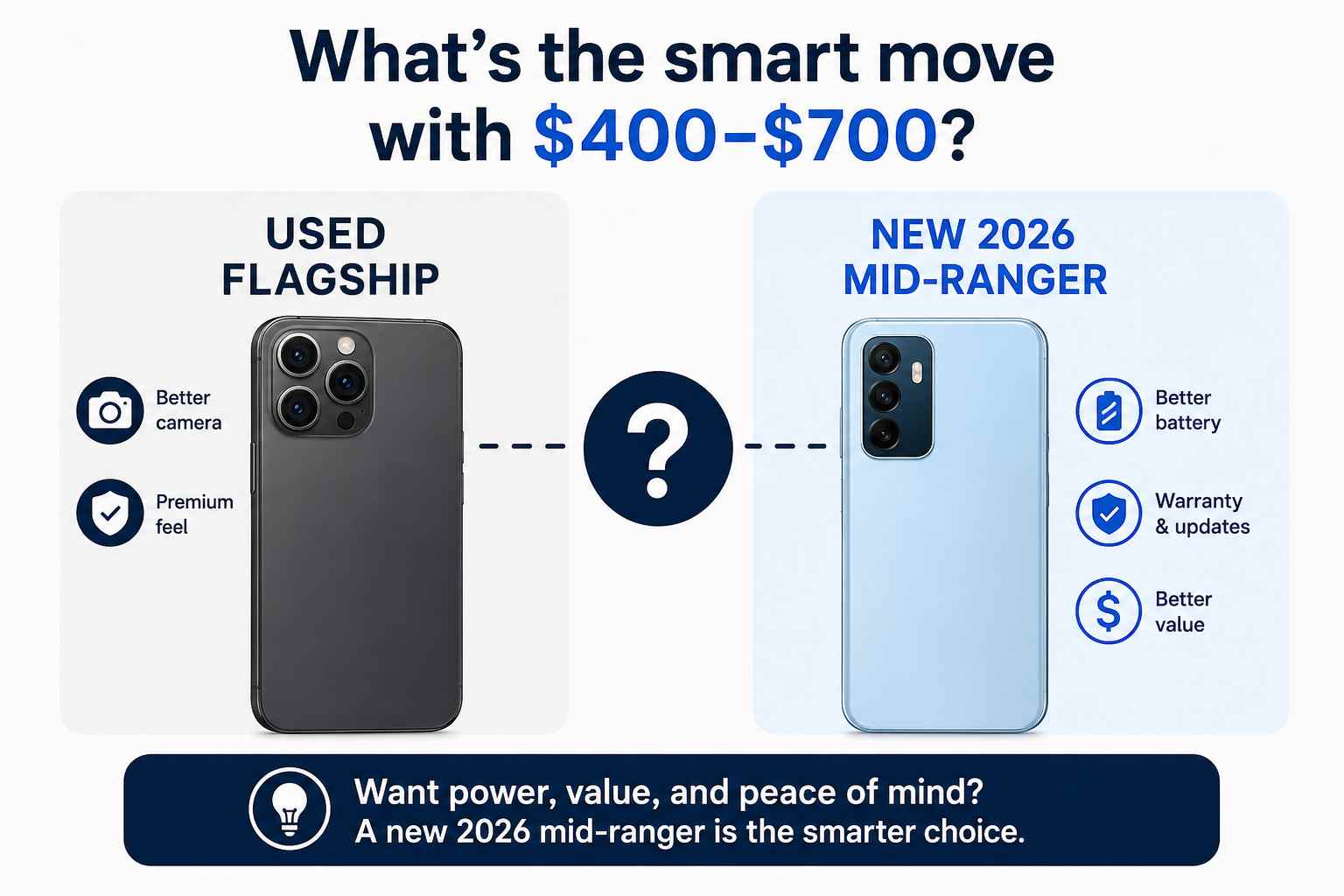
If it's the camera and build quality that matter most to you, here's my blunt opinion: a brand-new 2026 mid-range phone usually isn't the answer if a great camera and a phone that feels genuinely premium in your hand are non-negotiable. Your two real options are a clean, well-cared-for used flagship or one of the few "high-end mid-range" phones that are essentially flagships with a different price tag.
A good example of the latter is the Oppo Reno15 Pro Max. It's "mid-range" on paper, but its camera setup is closer to that of a flagship than anything else in the $300–400 bracket: a 200 MP main sensor, an actual 3.5x optical telephoto lens and a 50 MP ultrawide lens, all wrapped in a glass and aluminium body with Gorilla Glass Victus 2. If I had to pick one phone from this whole list purely for photography, this would be it without hesitation.
The other phone that catches my eye for its build quality is the Huawei Nova 15 Pro — that LTPO OLED panel hitting up to 4000 nits and the 100W charging are genuinely flagship-tier features, and the triple camera with a 3x telephoto lens is impressive. My only real reservation, and it's a big one, is that it runs HarmonyOS instead of Android with Google services. If that doesn't bother you (or if you're already in the Huawei ecosystem), it's a beautifully made phone. However, if you rely on Gmail, Google Maps and the Play Store, you will be frustrated by this phone no matter how nice the screen looks.
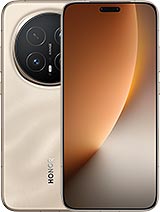
Then there's the Honor Magic8 Lite, which I have mixed feelings about. The 8,300 mAh battery is enormous — genuinely one of the biggest I've seen on a phone this size — and the AMOLED screen looks great. However, the Snapdragon 6 Gen 4 chipset is the same performance tier you'd find in phones costing $300 less, and despite the near-$700 price tag, the frame and back are plastic. To me, it feels like you're mostly paying for the battery and screen rather than any "flagship-grade" features.
So, to sum up, if camera quality and that "premium" feel is your priority, a clean, used flagship from one or two generations ago will usually outperform a brand-new mid-range phone in terms of photo quality and feel — and the Reno15 Pro Max is the closest a "new mid-range" phone gets to closing that gap.
If battery life, warranty, and years of software updates are most important to you, then the situation is turned on its head. Honestly, this is what I recommend to most average users. If you’re worried about whether this device will continue to receive security updates after three years, or whether the battery will last a full day after a year of use, buying a new mid-range phone from 2026 with a new warranty is the best option. As for a used flagship phone—even if it’s in good condition—the number of charge cycles is still unknown, and its warranty is either expired or about to expire.
The Google Pixel 10a is a prime example of this. For $449, you’ll get a 6.3-inch P-OLED display with a 120Hz refresh rate, a Tensor G4 processor that rivals the performance of flagship phones, a camera that scores 149 on DxOMark, and, most importantly, Google’s promise of major Android updates for years to come. If you plan to use your phone for four or five years, this feature alone makes the Pixel 10a a worthwhile option. My only complaint is the 30-watt fast charging, which feels slow in 2026, especially when there are phones half the price that charge faster.
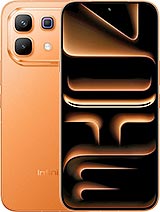
As for the Infinix Note 60 Pro, it really surprised me. A 6,500 mAh battery with 90-watt fast charging and wireless charging at a price of $450 is unusual, but the AnTuTu score—which exceeded one million points—made me reconsider. This level of performance was exclusive to flagship phones just a few years ago. The only drawback is the USB 2.0 port, which is a minor inconvenience when transferring files but doesn’t affect everyday use.
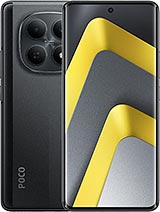
The Xiaomi Poco M8 is the best value for the price at $329, and I think it’s a good choice if your expectations align with the price. The AMOLED display and 5,520 mAh battery with 45-watt charging are good for the price, but the third-generation Snapdragon 6 processor is noticeably weaker than the Infinix processor, which outperforms it. Also, the lack of NFC is a real drawback if you use mobile payments. It’s a “get-the-job-done” phone, not a standout device.
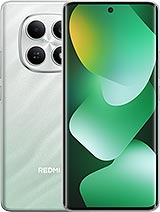
As for the Xiaomi Redmi Note 15 4G, I’d advise you to proceed with caution when buying it. A 108-megapixel camera and a 6,000-mAh battery look impressive on paper, but this phone only supports 4G networks, lacks NFC, and features the weakest processor on this list—the Helio G100 Ultra, which performs significantly worse than the Infinix and even the Poco processors. To me, this phone feels like it was designed around two or three big, marketable numbers, while the rest of the specs were sacrificed. If 5G isn’t really important to you, and you’re mainly looking for a large screen and a massive battery for media consumption, that’s fine—but I wouldn’t call it “powerful.”
Let’s talk about money, because that’s what everyone’s talking about in 2026
Here’s what no one is saying: The performance gap between flagship and mid-range phones has narrowed significantly this year, while the price gap remains vast. Two or three years ago, it would have been impossible for a phone like the Infinix Note 60 Pro to score over a million points on AnTuTu at a price of $450—that was the exclusive domain of flagship phones. The Tensor G4 processor in the Pixel 10a is the same one used in Google’s flagship phones. So, unless you absolutely need the very best camera (which is only available on true flagship phones and phones like the Reno15 Pro Max), a new mid-range phone from 2026 gives you 85–90% of the flagship experience for roughly half the price, complete with a comprehensive warranty.
If you decide to buy a used flagship phone
I’m not against used flagship phones at all—I’ve bought a few myself—and when you find one in good condition, it really is the best choice in terms of camera quality for the price. But there are two things I check on every used phone before buying it, without exception:
Screen burn-in. Set a gray or white wallpaper, turn up the brightness, and look for any faint traces of the status bar, navigation buttons, or app icons. Permanent shadows may appear on OLED screens that have displayed the same UI elements for years, and this is one of the things sellers most often “forget” to mention.
Battery health. Check the battery health percentage in Settings (or via a third-party app on Android). Anything below 80% means you’ll likely need to replace the battery within a few months, and the cost of that should be deducted from the phone’s price.
So, what’s the best way to save money while still getting a powerful phone?
This is the most common question, and the simple answer is: choose a new mid-range phone from 2026. You’ll avoid the risks of buying a used phone, you’ll get a full warranty, and as the numbers above show, you won’t lose as much performance as you might expect.
If I had to pick a phone that combines power, practicality, high efficiency, and an affordable price, the Infinix Note 60 Pro would be at the top of my list—its AnTuTu benchmark score, 90-watt fast charging, and wireless charging, all for $450, make it an irresistible choice. Right behind it is the Google Pixel 10a if camera quality and long-term software support are just as important to you as speed. And if you’re on a tight budget and just need a reliable phone for everyday use, the $329 Xiaomi Poco M8 meets the basics without making claims it can’t deliver on.
Bottom line: Don’t consider buying a used flagship phone unless camera quality and premium design are your top priorities, and you’re careful to check the screen and battery first. For everyone else—especially if your goal is “years of trouble-free use”—a new mid-range phone from this list will be a better choice and save you money.